


CPV in marketing is a widely used metric that determines the cost per qualified view. Very useful for businesses of all sizes, planning this number well can be crucial to achieving your prospecting goals on services like YouTube and TikTok.
Clear Definition of CPV and How it Works
So, what does CPV mean? The term CPV refers to the amount you need to invest in ads. It’s important to note, however, that the cost is calculated based on qualified views, not time or any other measurements.
This means that Cost Per View advertising prices are structured so that the advertiser only pays when a user actively interacts with their ad. In other words, there is not necessarily a financial loss when an ad is displayed and no one clicks on it.
For this reason, the terms “view” and “impression” are used in the context of cost per view in advertising. The latter is used to identify when the ad is displayed, but the consumer has not interacted in any way, for example, by clicking or viewing for 30 seconds or more.
To advertise in this way and generate more views than impressions, the first step is to understand how this feature works so that you can utilize it effectively.
- Type of interaction. It’s the criterion that determines if an interaction is a view or just an impression. It could be clicking on a button or watching for a minimum amount of time.
- Payment method. This is an auction-based bidding system, in which clients with the highest CPV bids have priority in displaying ads.
Considering these two aspects of the cost per view calculation, whenever the maximum value defined in the payment method and the predefined interaction types are applied, you obtain a qualified view.
How Do You Calculate The Cost Per View For a Video?
If all the money invested translates into views, calculating CPV is the simplest thing to do! Just divide the total amount invested in ads by the total number of qualified views, like this:
Cost Per View (CPV) = Total Ad Spent / Total Number of Qualified Views
You already know what CPV is, but let’s take a look at the other two in the cost per view formula!
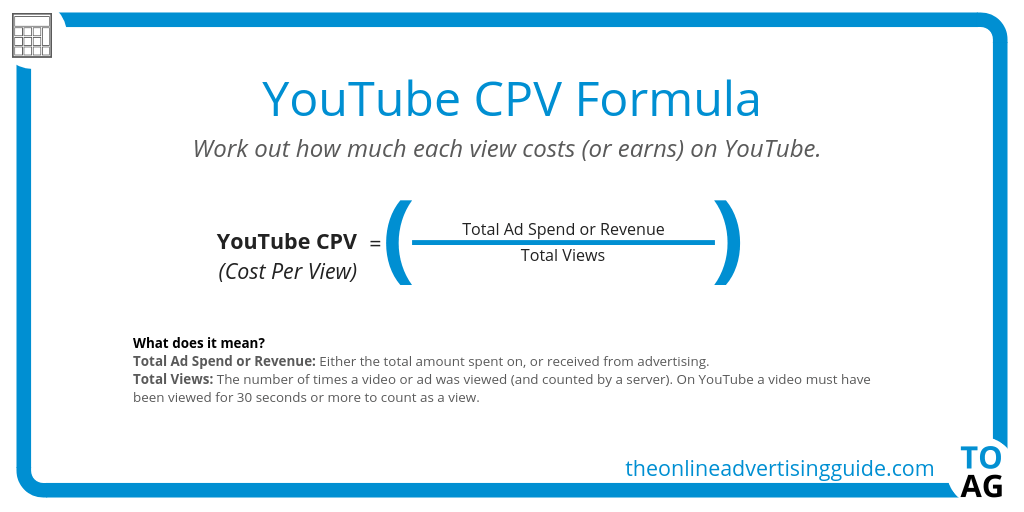
Total Ad Spent: also known as the budget, is the amount previously defined by the client for the advertising campaign.
Total Number of Qualified Views: the number of times an ad meets the criteria for being viewed, therefore excluding impressions.
Now that you know how to calculate cost per view, why don’t you take it a step further?
Campaigns on digital platforms, such as YouTube, have varied purposes, including awareness, engagement, and sales, each with its own healthy CPV levels. Therefore, it’s your chance to consult a specialist to obtain the most suitable strategy for you!
