


Customer Acquisition Cost (CAC) shows how much a company pays for each new customer. It is one of the basic and most common metrics in marketing.
To calculate CAC, you have to divide all marketing and sales expenses by the number of new customers you managed to acquire over a specific period.
For example, the CAC formula for a specific marketing channel will look like this:
Advertising expenses per channel / the number of customers acquired.
CAC and LTV — The Ratio That Determines Growth Health
Customer Acquisition Cost only becomes meaningful when measured against Customer Lifetime Value (LTV) — the total revenue a customer generates over their entire relationship with your business.
The CAC:LTV ratio is the standard way to judge whether your acquisition spending is sustainable:
CAC:LTV ratio = Customer Lifetime Value ÷ Customer Acquisition CostA ratio of 3:1 is widely considered the baseline benchmark for a healthy SaaS or subscription business — meaning for every $1 spent acquiring a customer, you recover $3 in lifetime value. A ratio below 1:1 means you are losing money on every customer you bring in.
| Ratio | What It Signals |
|---|---|
| Below 1:1 | Acquisition model is unsustainable |
| 1:1 – 2:1 | Breakeven or marginal; hard to reinvest in growth |
| 3:1 | Healthy; standard benchmark for SaaS |
| 5:1+ | Strong unit economics; room to scale spend aggressively |
A very high ratio (e.g. 10:1) can also be a warning sign — it may indicate you are under-investing in acquisition and leaving growth on the table.
How do Businesses Benefit from Customer Acquisition Cost Optimization?
When you understand customer acquisition costs, your business can take advantage of the following benefits:
- assess overall marketing efficiency;
- understand which customer acquisition channels are most efficient;
- determine the optimal budget to avoid overspending;
- improve sales strategies and develop efficient ways for customer attraction and retention;
- choose and estimate the size of a potential discount for loyalty programs;
- assess how profitable advertising investments are and make an informed decision on resource allocation.
If customer acquisition costs are too high, a specific sales channel or promotion method is unsuitable for the business.
3 Simple Ways to Reduce Customer Acquisition Cost
Reducing CAC is not simply about cutting spend — it is about improving what each dollar produces. The most effective approaches:
- Invest in conversion rate optimization (CRO). Improving how your website converts existing traffic is often the fastest path to lower CAC. A/B testing landing pages, reducing form friction, and strengthening calls-to-action can double conversion rates without any additional ad spend.
- Build organic acquisition channels. SEO, content marketing, and community building have higher upfront costs but produce compounding returns. Unlike paid channels where CAC is immediate and ongoing, organic channels generate customers at decreasing marginal cost over time.
- Use video to compress the sales cycle. Product explainer videos, demo videos, and customer testimonial videos answer prospect questions before they reach a salesperson. When a lead arrives already understanding your value proposition, the cost of converting them drops — fewer calls, shorter cycles, less sales team time per close.
Summing Up
In marketing, you can calculate this metric for different channels, multiple periods, and various advertising campaigns.
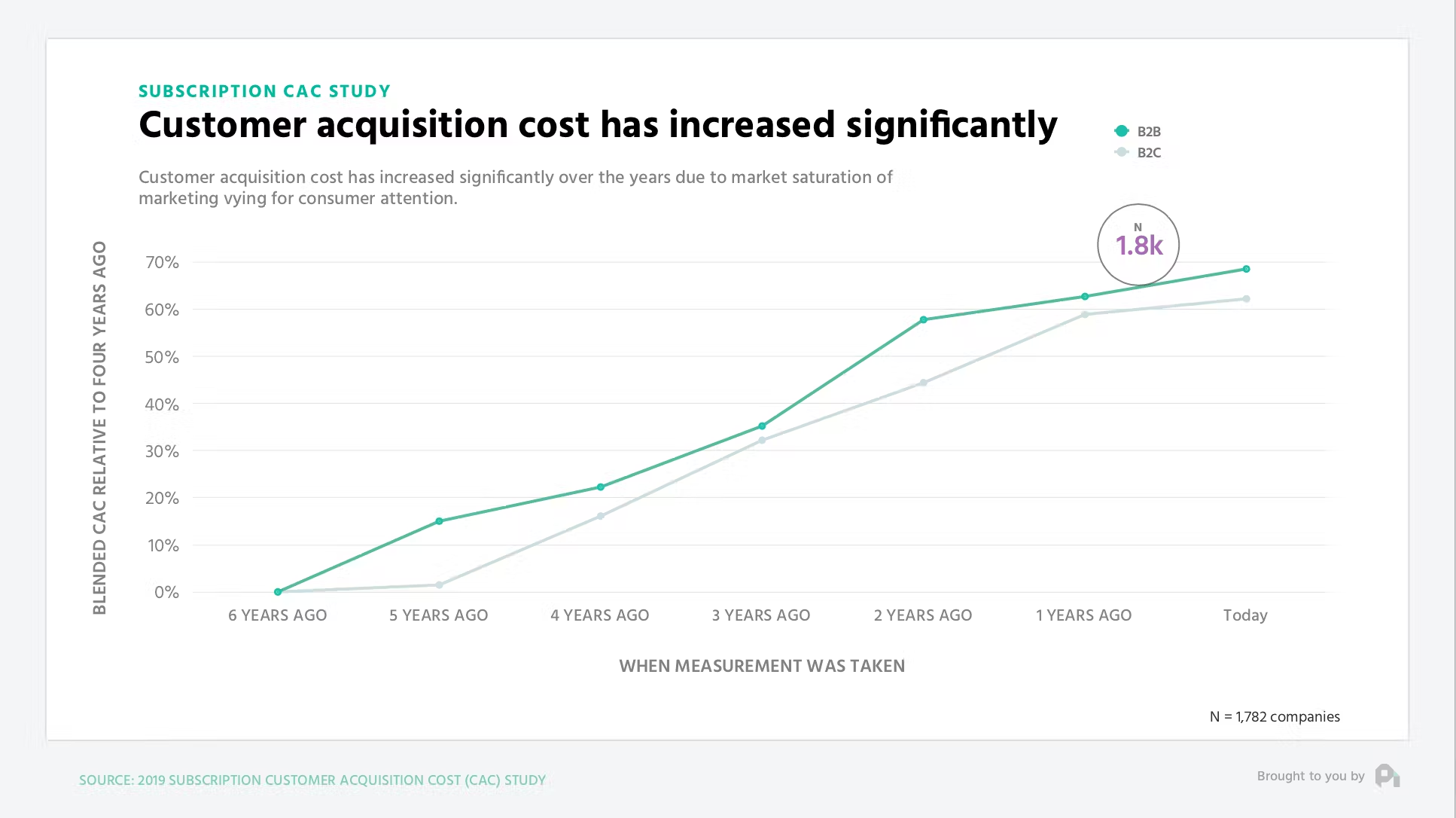
Customer Acquisition Cost (CAC) is not a static metric and can change depending on various factors, including new acquisition channels, customer behavior, and market environment.
“Corporate training videos are short films produced for internal use within an organization. The goal is to educate employees on new skills, company policies, compliance, safety procedures and more. Videos provide an engaging and effective way to train a distributed workforce.”
