
Just creating a one-off video, even if it’s the best video in the history of video marketing, won’t guarantee good results.
If you are looking for your video strategy to work, and see tangible video marketing ROI, you need a set of things to come together: a clear, defined goal; making sure that you are using appropriate formats, lengths, and creatives for each channel; and a continuous optimization process to actually make a difference and bring your business leads.
Here, are covering how to calculate ROI in marketing for video – as well as a set of ways to increase marketing campaign effectiveness, while also having countless pieces of advice from our team over at Zelios – all with practical examples.
Video marketing delivers strong results: 92% of marketers report positive ROI, with video driving 48% more conversions than other content. It boosts email click-through rates by 300%, landing page leads by 32%, and sales response rates by 2x. — Dash
How to Measure the ROI of Your Video Marketing Efforts
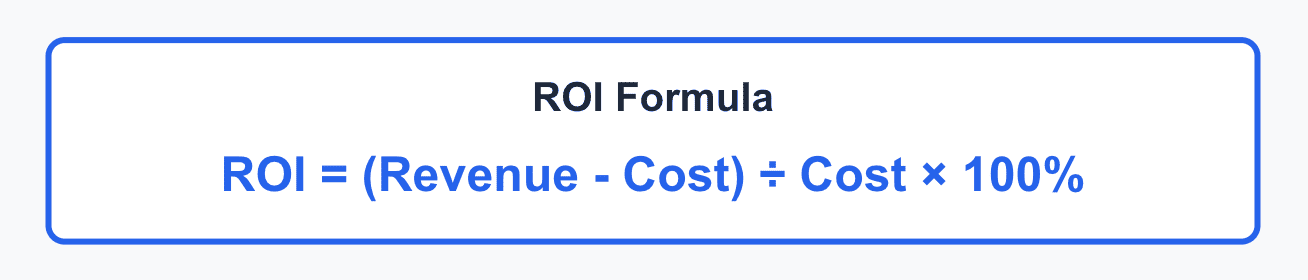
Let’s start off with a bit of math. As people measure different things, there’s no one way of how to calculate roi in marketing. So for the sake of clarity, we we will be keeping our equation simple:
ROI = (Attributed Revenue – Total Video Cost) ÷ Total Video Cost
- Attributed revenue can be connected back to sales, pipeline influenced – so whatever was set & designed for the video to influence. As much as it’s great to hear “we’ve seen the video so reached out” – it’s only relevant once everything is calculated with real numbers.
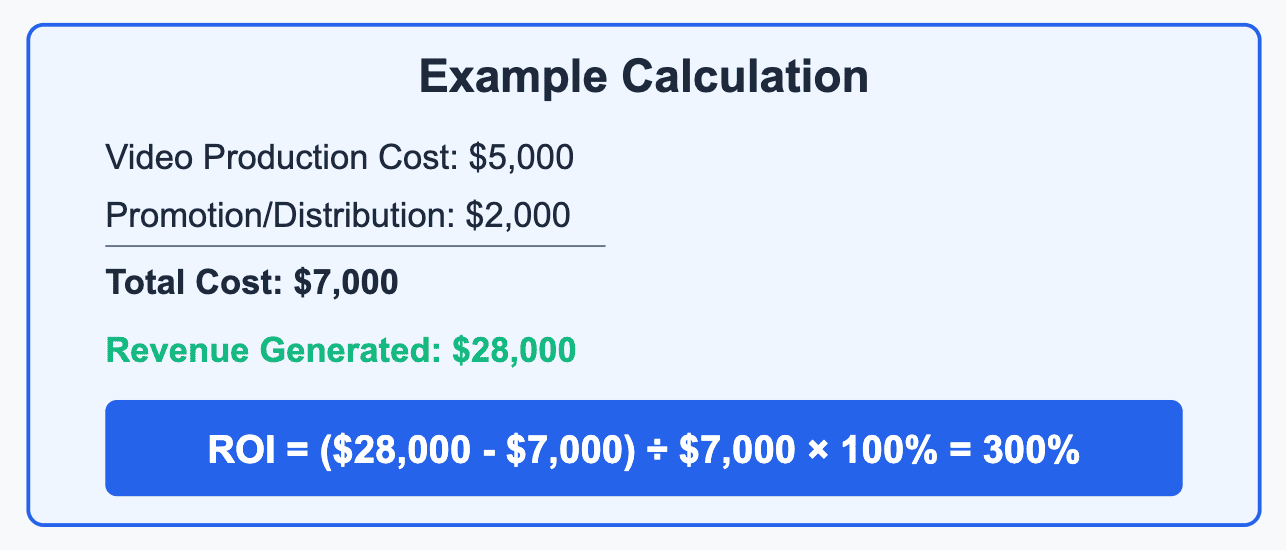
Total video cost includes the total budget that went into production of the video – so of course strategy, scripting & concept, full production and post production, whatever the localization needs are, testing of the creatives, media spend, tools and internal back & forth costs.
This is one of those points where we say that cheap video is more expensive – but those costs are invisible: from time lost on back-and-forth regarding the revisions, to doing parts of the visuals in-house – and finally, getting subpar video content – all of these are hidden costs that come with going with a “cheaper” upfront cost.
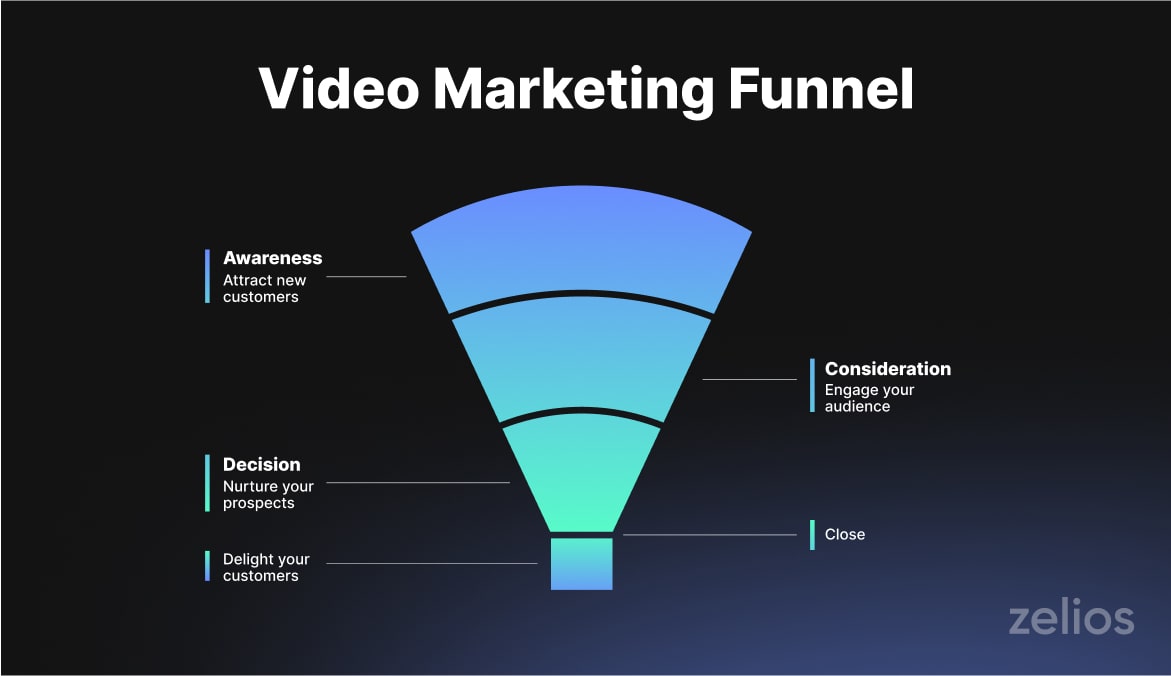
Track by funnel stage (so the math stays honest):
- Awareness: see how well you are reaching your target audiences, and check at the 3s viewthrough: if you see a mediocre performance for the hook, you need to adjust it immediately. People are unforgiving, and even the best videos underperform if they flop it in the first seconds.
- Consideration: here, you can take a look at the landing page CTR, and how many demo/trials started. This way you can see how many conversions the video content has assisted.
- Purchase: compare the customer acquisition cost in the before and after of the video campaign. This will help you calculate the revenue that was influenced.
- Retention/Expansion: here, you need to check activation rates, churn and rates of upsell.
Attribution hygiene (before you launch):
- Set a clear, single metric per asset. Too many goals = vague reporting = hard to set attribution.
- Lock in your UTMs, and campaign naming by source/medium/content.
- Work with a dedicated agency, or set up the ad platforms to analytics + CRM in-house.
- Set lookback windows and a conversion of record.
Use incrementality/lift tests where you can to properly measure ROI in advertising across channels.
 Zelios rule:
 8 Proven Ways to Maximize Your Video Marketing ROI
1) Map Videos to the Customer Journey
Ads, explainers, tutorials…all of these have their own names. But these are not just names: they serve to solve a real bottleneck: Awareness (launch ads, feature updates, usually 6-30 seconds in length), Consideration (60-90 second Explainer video & testimonials), Conversion (demo & walkthrough videos, normally around 30-60 seconds in length), Retention (testimonials, customer stories, onboarding video videos, walkthroughs and feature update videos – varying from 30 seconds to 2 minutes).
Insight from Zelios: If you are looking to learn and do something the right way – sometimes you do it by learning how to do it the wrong way. When you keep churning out situational, one-off video – you might be hurting your video strategy, which is at the heart of building a ROI based approach.
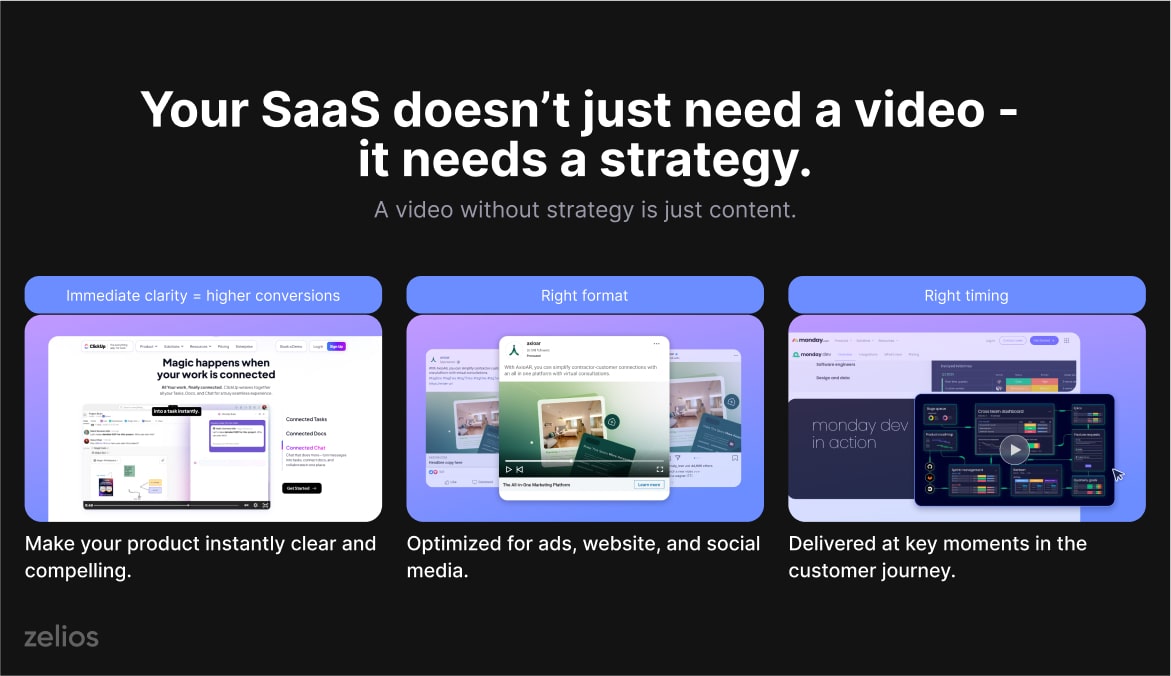
Well planned video strategy, with the right format, presented at the right time – your content can outperform the standard, vague roi for video content, and go beyond vanity metrics like numbers of views, comments, and more.
When you are always scrambling to release last minute, one-off videos – you are neglecting strategy – which makes you stay behind your competitor, and doesn’t help your ROI either.
2) Choose the Right Video Types for Your Funnel
But how do you actually tackle strategy, and content? While moving from zero content, to at least one great explainer video is a great start, real efficiency starts when you use a particular format for the job it does well.
Again, there’s no one single magic pill that you can use, but you can learn from the best performing SaaS examples.
Top-of-funnel (Video Ad): When looking at top of the funnel, what we see is fast paced videos with quick hooks, ideally focused on a single promise or a dream outcome, leading to one CTA and being less than 30 seconds. Fast, clean – and hype to build momentum.
Example — LangEase (Launch Ad):
By using clean design & motion language, intentional silence, 3D UI & advanced lighting with crisp typography – with LangEase, you have a dynamic mix that calls back to Apple & Gemini – “borrowing credibility”, which is always good for smaller brands. With ToFu content, where the pace is quick and you need to earn trust rapidly – this style boosts marketing campaign effectiveness, and can be done on a reasonable budget.
Use them to attract attention at scale, across paid & owned media.
Example — IBanFirst (Fintech Demo):
Some of the more conservative niches like finances, benefit from showing a bit more of the product – not just from showing the surface-level magic, but actually showing how the magic happens. Again, this still stays within that ad realm, where we don’t focus too much on the actual workflow, but are using elegant 3D depth, transitions and idealized UI to show a reliable, yet still a very innovative workflow.
Especially when stakeholders are risk-averse, mixing in premium motion with the “how it happens” part – helps with increased conversions.
Use it with conservative niches, age-old workflows, and to show disruptive workflows & approaches without diving too deep.
Middle-of-funnel (Explainer): Compress the learning curve; 60–90 seconds.
Examples — HawkSearch & StoreTrack:
As we progress through the funnel, we will see a lot more methodical examples, with step-by-step value stories that are packaged in dynamic animation & strong, on-brand design. Examples like HawkSearch & StoreTrack serve as good examples of tools to move viewers from “What is this, I might need it” (especially if they converted through a top of the funnel ad) to “I get it, and need it – show me more”.
This is the first spot where roi in video marketing actually starts compounding, as your video funnel leads the prospect from problem unaware, to interested and ready to explore more – without long calls & browsing though your static content.
Bottom-of-funnel (Micro-Demo / Tutorial): One job-to-be-done, one outcome.
Example — LangEase (How-To/Tutorial):
With this example, we are looking at why it’s important to have the strategy paired with format discipline – same product, but these videos serve a different goal.
Here, we are looking at practical “how to do this now” styles – guiding already interested prospects that received a concept level understanding of your product by watching an Explainer or Product video.
Insight from Zelios: 3) Use Strong and Clear Call-to-Actions
If you are not harvesting the eyeballs in the video properly, you might be wasting your marketing budget. Once you’ve done an amazing video, within the proper format & established goal – it’s time to use a clear CTA to convert that attention. As with the hook, which is used to grab attention – having a great CTA is a big part of where & how your viewers will interact with you.
Checklist
- 1 verb + 1 outcome: Start free trial, Book a demo, Join waitlist.
- Avoid dual CTAs (paradox of choice) – don’t give people too much to do.
- Use clickable overlays/cards where supported; keep the CTA button visible near the player on your page.
We are seeing watchtimes shrink – even with dynamic videos like the LangEase Video Ad which we’ve discussed above. So don’t miss the mark with those viewers that actually watched your video until the end, with full intent – give them a crystal clear, single next best step.
4) Simplify Complex Ideas with Explainer & Demo Videos
Explainer & Demo Videos really pay off when your buyers finally:
– Have clarity about your product;
– Won’t need to spend hours browsing your landing page or static content;
– Pre-frame or pre-handle objections that can come up during a discovery & demo calls;
– Reduce the amount it takes from first interaction with your product, to having a good grasp of your value proposition.
Structure you can use: Problem, Value or Solution, 2-3 Proof points or “Moneymaker” feature, and closing with one, clear CTA.
Why it lifts ROI:
You avoid having people that are unqualified for your product; they “get it faster”, so your accounts & sales team can ask better questions, and build a long time partnership. Because you have more qualified people, you can close faster, upsell them more – which results in a better roi for video content.
Insight from Zelios: Videos like Univer become more than an aggregation of screen shared videos, showing the workflow. By making them much more appealing, and showing the ideal workflow – people get it faster, and show improved adoption rates when faced with the real platform environment.
5) Use a Distribution-First Strategy
What we have at this stage is using the right formats to work more efficiently – thus making sure you are not dumping your budget into a black hole. Next thing we can do – is give your video content wings, by talking about the best use cases to spread it across your owned and paid channels.
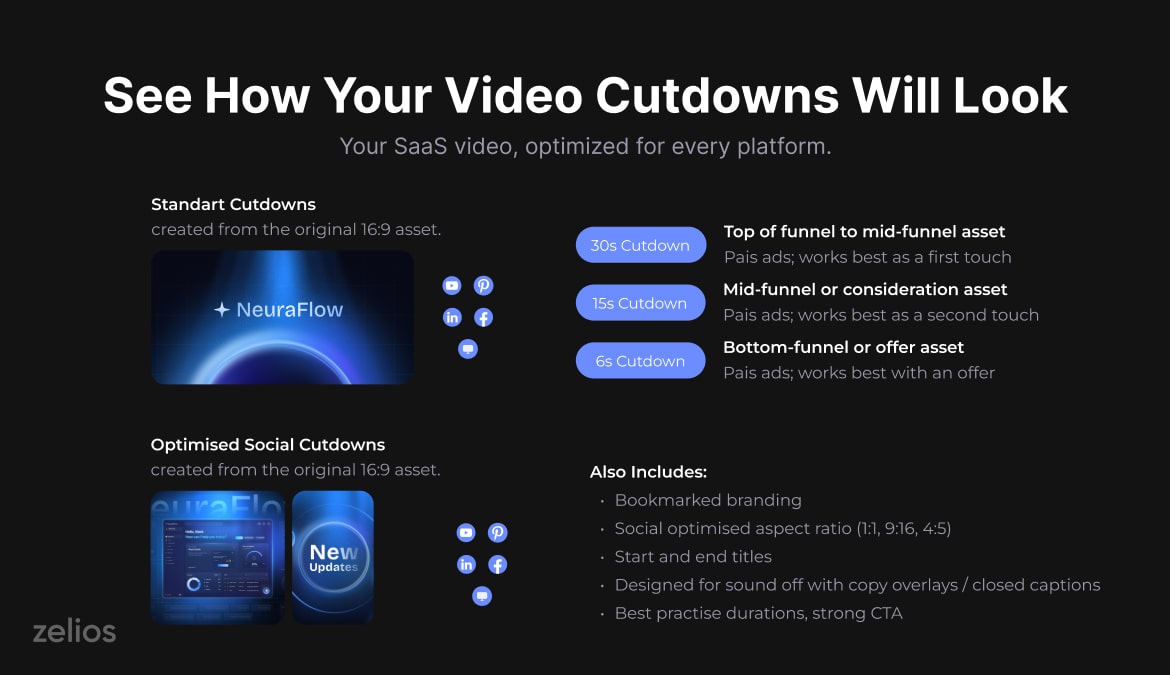
We often plan this out before animate: by knowing the overall intent, we can increase the production efficiency, by working on different formats in advance, or planning for cutdowns, localizations and a variety of different adaptations in advance.
If you need a simple plan, do this
- Pick content distribution channels and native ratios (9:16/1:1/16:9) – content takes off and gets promoted better when it works with native resolutions of platforms.
- Design thumbnails/first frames as mini-billboards – again, calling back to the hook discipline. Your thumbnail and first frames are crucial.
- Budget paid + organic; stage your flight dates – again, Q4 is always more expensive when it comes to ads and placements.
- Build retargeting cohorts (watched ≥50%, visited LP/no form, trial no activation).
Insight from Zelios: The less of a video system & strategy you have – the harder it is to actually figure out how to calculate ROI in marketing.
6) Maximize Your Reach by Content Repurposing
If you play it smart, you don’t need a bottomless purse to cover all placements, and all use cases. After building your flagship piece of content, like a Launch Ad, or an Explainer/Demo – you can make sure it goes much further, without overspending on extra videos.
Here’s how it works.
- If you have different niches & ICPs you are targeting – best case scenario is creating tailor made video for each and every one of those. But if you are looking to go lean, you can plan out a variety of videos by repurposing & adapting the hook for each ICP. You can keep the middle part of the video the same, but adjust the hook & CTA to work with the particular ICP.
- Your 40-60 second video can be adjusted into “coming soon” or “teaser” videos – that are around 10-15 second long and used for additional hype. They should also be adjusted to phone formats, into 9:16 and potentially into 1:1.
- Derivative assets from the video – like design & animations, can be used as separate GIF loops on your feature pages, email campaigns.
- Stills can be grabbed almost as-is, and used for PR events, pitch & sales decks.
Don’t just spend a bunch of budget, and hope the ROI will skyrocket. Set up your video for success. Instead of popping up one time in the feed of your prospects with a single 60 second video, make sure that you can poke them consistently, and meet them where they are.
And it doesn’t really strain the budget too much. By creating additional cuts, you are going 10-11x the impact from your hero video.
Insight from Zelios: Don’t just spend a bunch of budget, and hope the ROI will skyrocket. Set up your video for success. Instead of popping up one time in the feed of your prospects with a single 60 second video, make sure that you can poke them consistently, and meet them where they are. And it doesn’t really strain the budget too much. By creating additional cuts, you are going 10-11x the impact from your hero video.
Even if you are tight on the budget, there are ways of how you can stretch the high end video – from multiple opening hooks to end-frames, and a library of static content pulled directly from video’s design.
7) Look for UGC Content Opportunities
This is something video production studios won’t say – but sometimes, the most efficient thing you can do is to not produce a premium video. If it’s not a crucial event, trade show, key product or feature launch – tapping into UGC or UGC-style content works like a charm.
If we are talking about best ROI for video content – these are your best performers. They are cheap to make, and if done right, you can even have them for free (if your product or affiliate program is good).
Where UGC wins
- Seeing real people using the product is something that everyone craves – especially if we are using an influencer within the niche (tech guru talking about a new SaaS) they are lending their credibility to the product.
- Cultivate community around your product – and give affiliate bonuses for them to build a library of how-to’s, tutorials and promotional materials around your product.
- Founder, product, and marketing team’s notes on “what’s new” helps put real faces behind the product, and can
As with the explainer formats, sometimes people just want to see relatable content with people. Additionally, you don’t need to have powerful and dynamic videos for ALL of your marketing use cases: even giants like Slack, that spend millions in marketing budgets, often tap into UGC or UGC-style video content, which are made by their internal marketing teams.
You never know what goes viral – especially when you are riding trends. If done right, the ROI on these are unmatched.
@slackhq Join in on the fun and sign up for our #Slack Community member-led sessions at Dreamforce. #DF24 ♬ original sound – Slack
8) Balance Evergreen and Timely Content
Again, it’s always about balance. Your evergreen content, like Explainer & Demo, onboarding & case studies – should be balanced out with more timely content, like launch ads, feature drops, and promos.
On this note, you can also balance the quality & format. Your heavy hitter, flagship premium content should be balanced with more light weight, quick to make solutions, like feature announcements & updates.
Working cadence
- Always have your evergreen content across website, social pages, feature & customer story pages – for improved SEO and better customer education, as well as sales enablement.
- Stay top of mind with feature announcements, small updates, even without investing in major productions.
High-end formats like a Launch Ad, similar to LangEase – are perfect for big moments, trade shows, and feature launches. But you most likely don’t need to go high-end every month – so with this in mind, you can mix in smaller demo’s, screen recorded updates, and UGC to keep the feed warmed up, without pumping budget into all of your video content.
Even Slack, with their marketing spend in the millions, mixes in more UGC & simpler feature videos.
Quick Walkthrough: How to Calculate ROI in Marketing (for Video)
- Define how the success looks – good example for SaaS & AI could be number of qualified demo in X days.
- Instrument: You can’t improve what you can’t measure – integrates UTMs, pixels and CRMs – into a single system to watch.
- Assign values: see how your content helps your sales flow from lead, to MQL – SQL – and revenue gained, to compare it with historical conversion rates or how it stands vs other campaigns.
- Total cost: calculate the costs of strategy, full production, and all of the reworks, media, tools – and something that flies under the radar, is the internal time it takes. All of this should be measured towards the total cost.
- Compute: (Attributed Revenue – Total Cost) ÷ Total Cost.
- Optimize: To continuously improve & measure ROI in advertising, and sustain your marketing campaign effectiveness – you need to update your content, switch up audiences, refresh the creatives and of course, in some cases, spend more budget.
Don’t go at it alone. Over 1000s of projects we’ve done, we can build a custom video funnel that will hit the mark for your video marketing strategy, while being mindful about being budget efficient.. There’s no “one size fits all” for video, and it’s the same with the strategy.
Final Thoughts
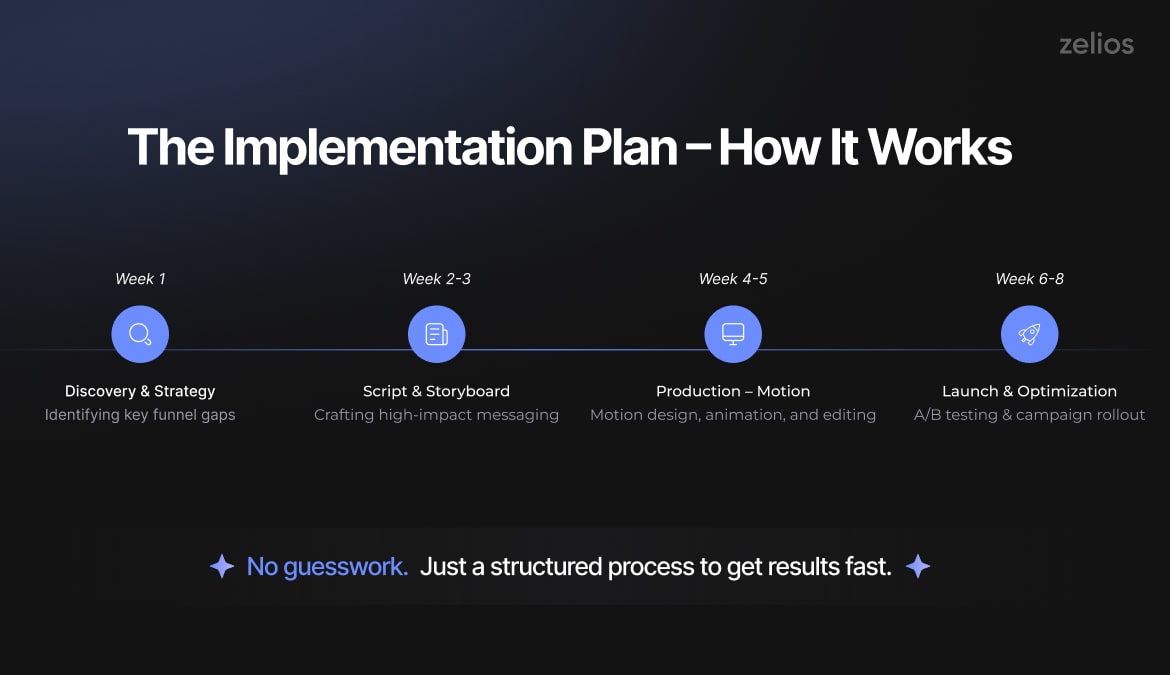
Maximizing video marketing ROI can come in different shapes & forms – bigger budgets don’t always help with that. If you are using the proper format that matches your intent, mindful about the real journey & lead stages, and have a smart & aggressive distribution strategy plan – you are doing it right.
If you do all of this, you won’t just know how to improve ROI in digital marketing – you will see it reflected in the bottom line.
Have a project in mind? Get started with Zelios! Our creative team would love to help you reach new heights.
Select the video type that aligns with your marketing objectives, and receive an immediate high-level estimate of the production cost.