

The global software market continues to grow, and software as a service (SaaS) remains one of its most promising segments. There is plenty of room for new players, and many niches where a strong product could flourish.
I’ve pulled together the facts and statistics that show where the SaaS market stands right now, which trends are picking up speed, and which ones will still matter over the next couple of years.
Every fact here has been checked, and the only sources cited are authoritative ones that publish verified data and their own research. This SaaS statistics page will be updated and expanded regularly.
—
SaaS Market Size and Growth
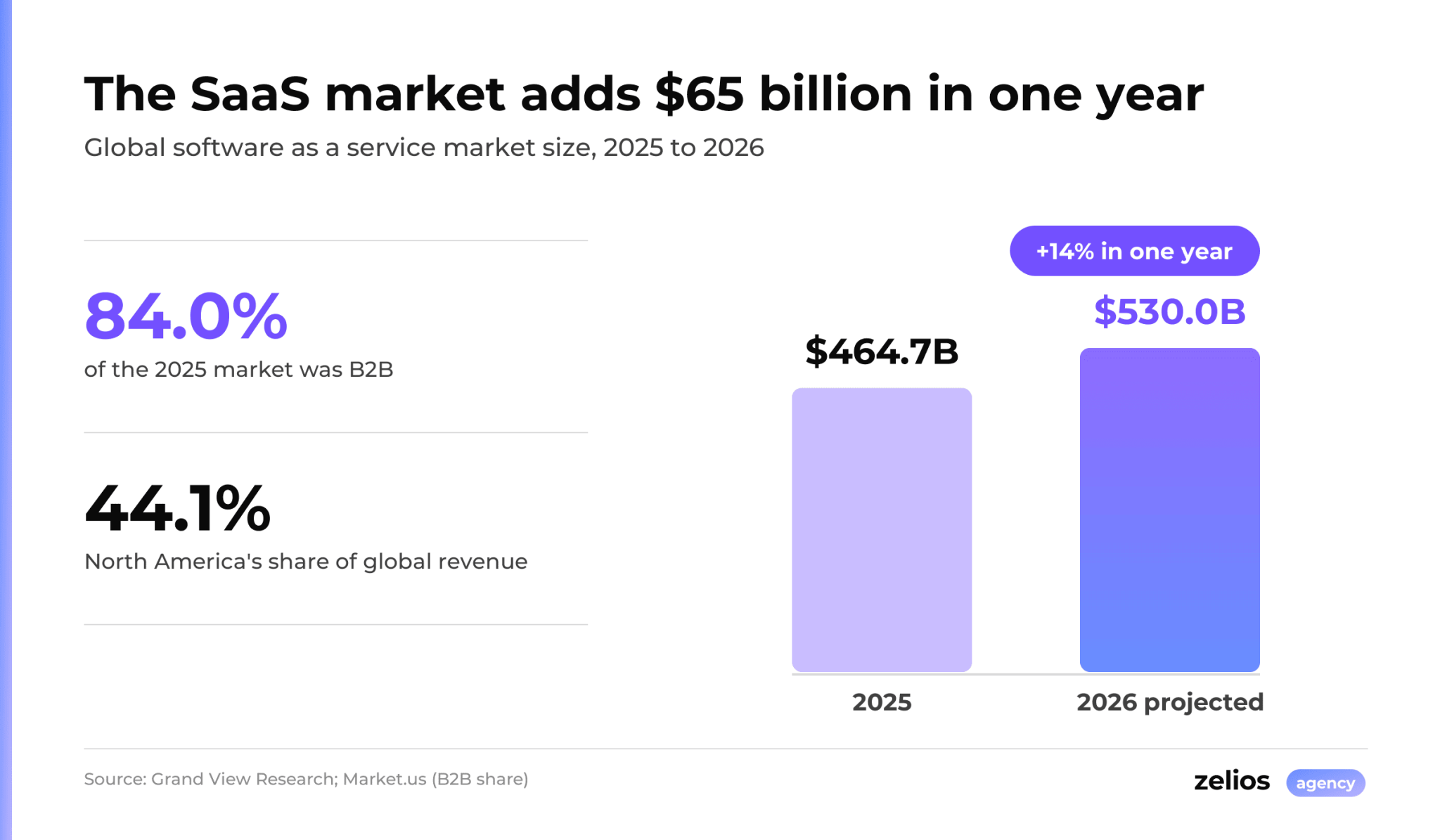
1. In 2025, the global software as a service (SaaS) market size was valued at USD 464.7 billion and is projected to grow to USD 530.0 billion in 2026. – Grand View Research
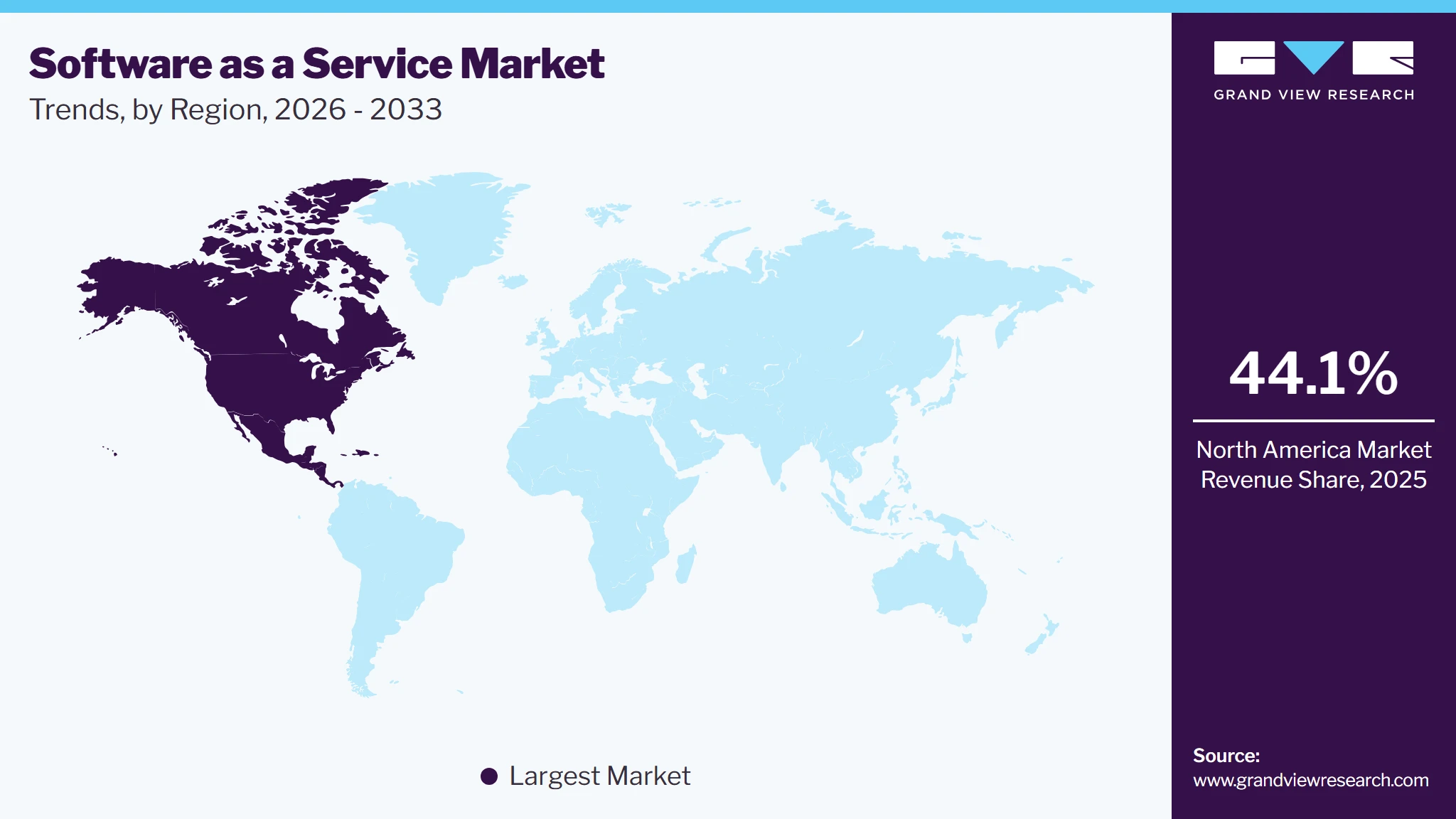
“North America dominated the global SaaS market, holding the largest revenue share at 44.1%. ”
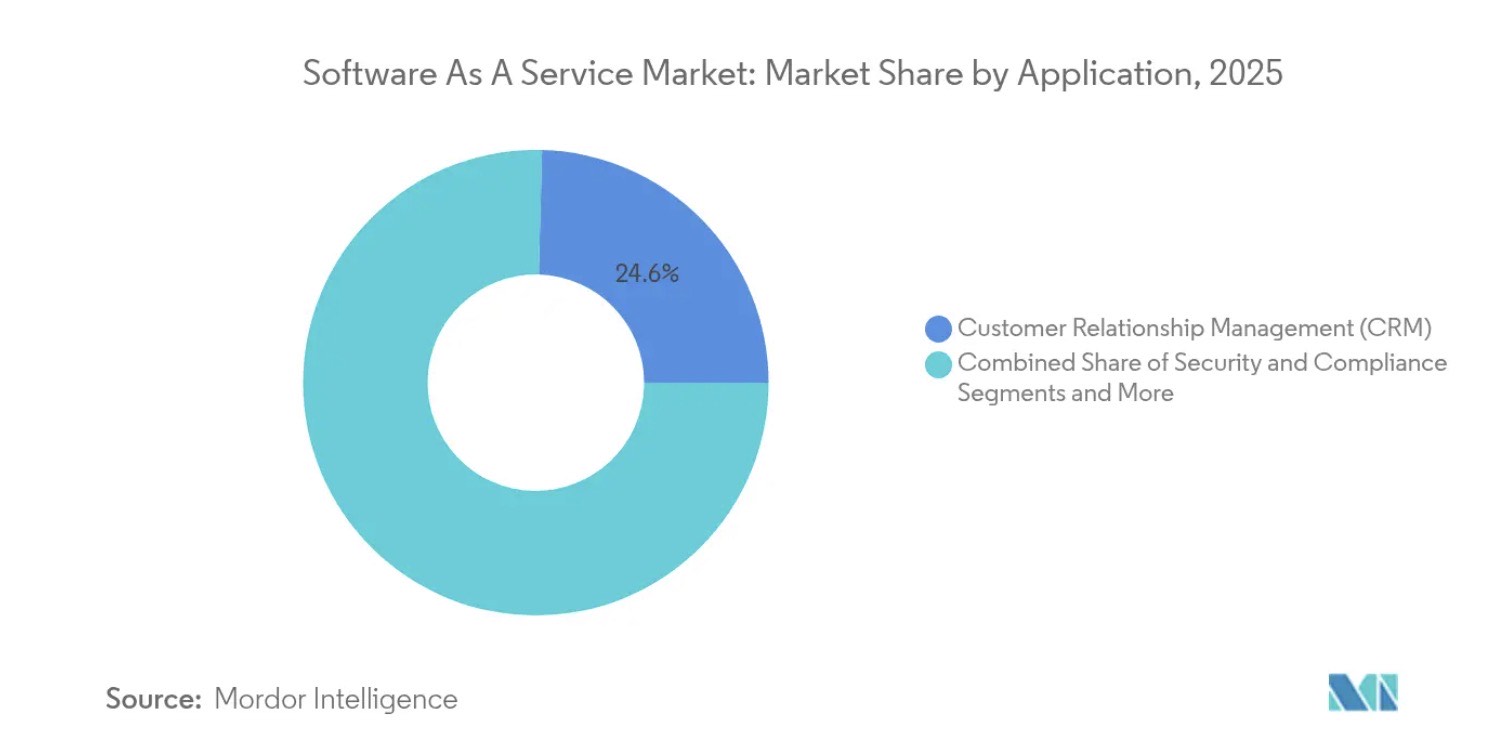
3. The SaaS CRM market size is expected to undergo growth from USD 54.98 billion in 2025 to USD 65.99 billion in 2026. – Mordor Intelligence
4. In 2025, Customer Relationship Management (CRM) products held the largest share of SaaS market at 24.58%. – Mordor Intelligence
5. SaaS revenue in Europe is responsible for between 23% and 28% of the world’s total SaaS income. – SearchLab.nl
6. Vertical SaaS is outgrowing horizontal SaaS in 2026, driven by stronger data moats and switching costs. Vertical SaaS grew 31% vs. 28% for horizontal, with a record 41% M&A premium in 2025. – The SaaS Library
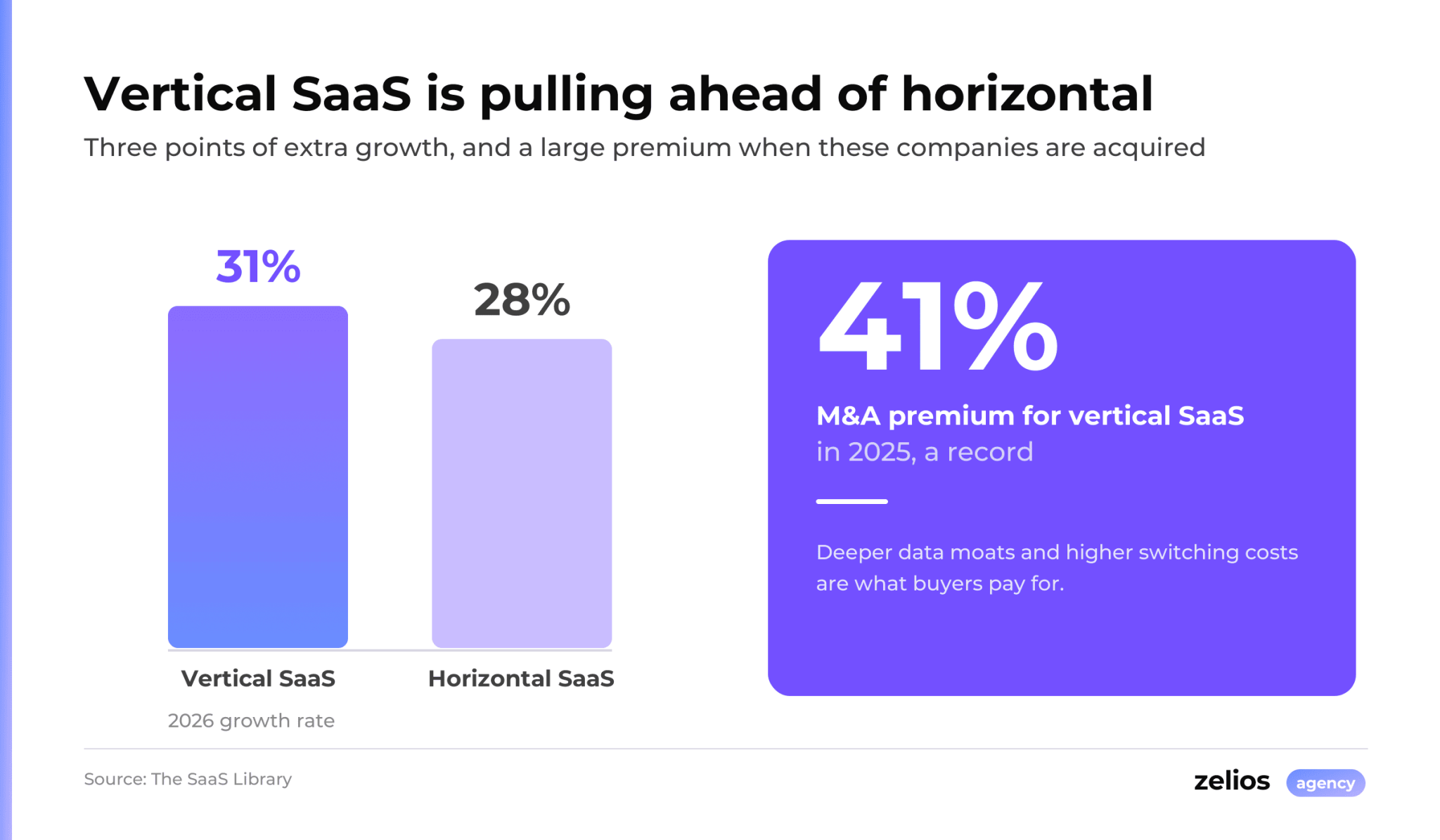
“The biggest opportunities in 2026 lie in “vertical SaaS” — tools built for one specific industry, such as “CRM for landscapers” — and AI-powered solutions.”
8. From September 2025 to September 2026, SaaS equity funding reached $315 billion across 3,450 rounds, marking a 158% increase. – Tracxn
9. SaaS funding rebounded in 2026, growing ~1.5× YoY, with 60–83% of early-stage software VC going to AI-native and AI SaaS companies. – SaasRise
SaaS Adoption and Usage
10. The Asia-Pacific region led all others in SaaS adoption, driven by its accelerated digital transformation and mobile-first business mindset. – Market.us
11. A total of 52.7% of EU enterprises used paid cloud services. Of those businesses, 96.4% purchased at least one Software as a Service (SaaS) application. – Eurostat
12. SaaS solutions account for 55% of software deployments across enterprises. – Business Research Insights
Revenue and Monetization Statistics
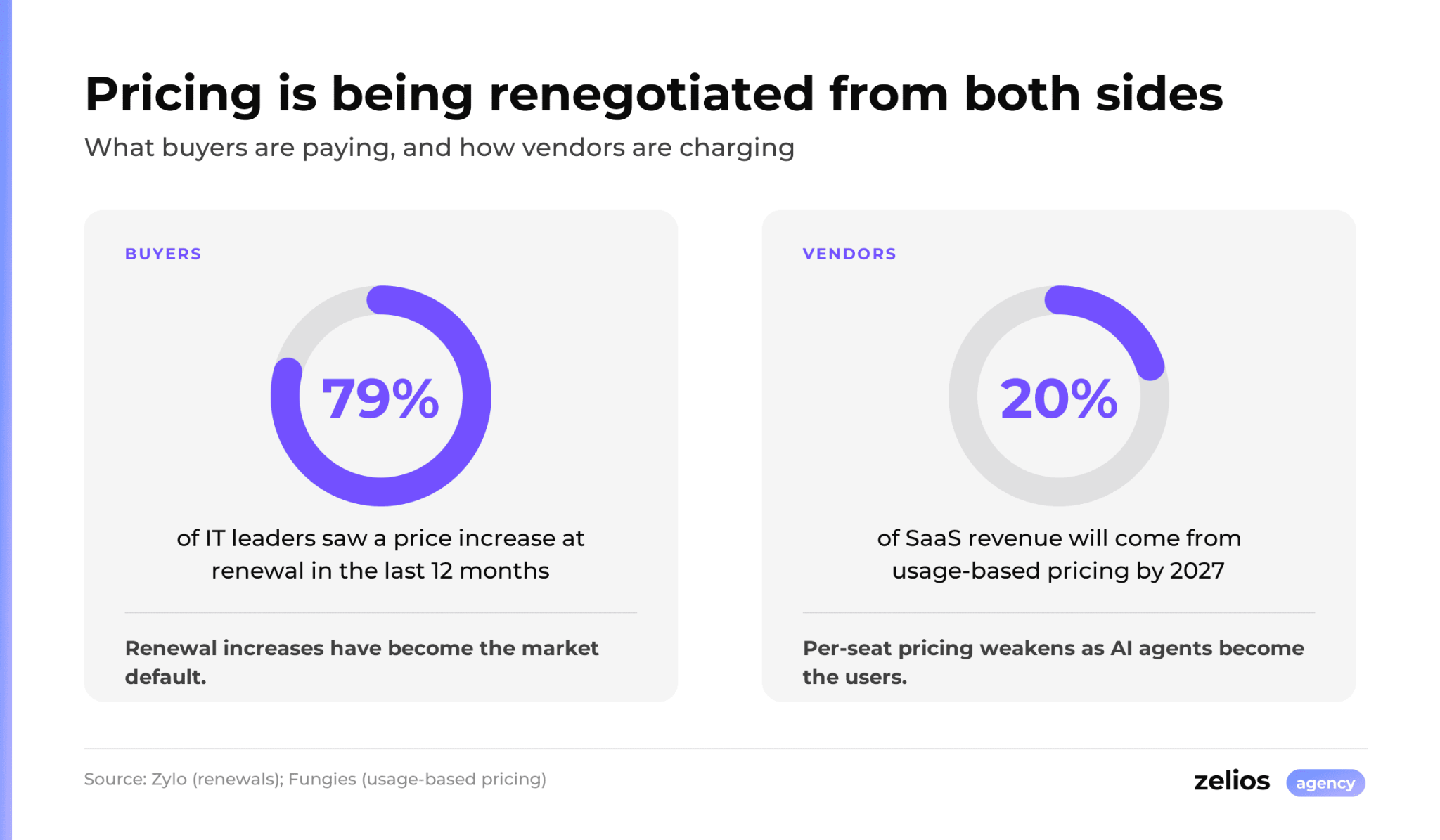
13. The usage-based pricing model is projected to account for 20% of SaaS revenue by 2027, up from a fraction of that in 2024. Conventional per-seat pricing is facing challenges as AI agents become more prevalent as users. – Fungies
14. In 2026, hybrid and tiered subscription models will remain the most popular SaaS monetization strategies, with an increasing shift toward “pay-for-work-done” usage metrics. – SaaS Mag
15. 79% of IT leaders have experienced price increases at renewal within the last 12 months. Renewal-time price increases have become the market default. – Zylo
16. Private B2B SaaS companies have a median revenue of $129,724 per employee, which is a strong indicator of overall productivity. – SaaS Capital
17. On average, B2B SaaS companies experience 3.5% monthly churn, split between 2.6% voluntary and 0.8% involuntary. – WeAreFounders
Acquisition, Sales & Marketing
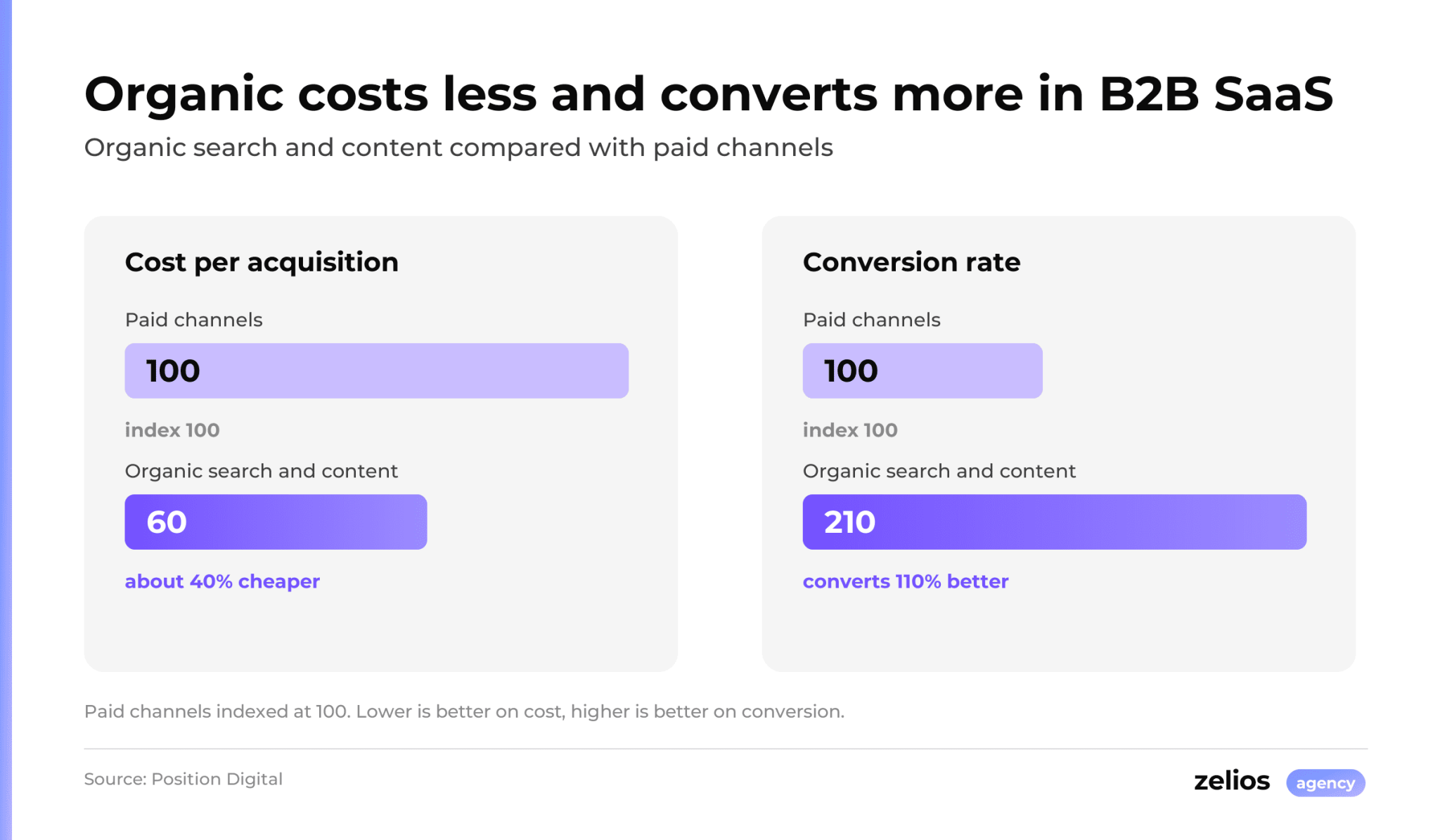
18. In B2B SaaS, organic search and content are almost 40% cheaper than paid channels, yet they convert 110% better. – Position Digital
19. A striking 91% of European buyers reject platforms that are not DSG or FedRAMP compliant, which is why it is so important for businesses to ensure that their platforms are compliant. – Scalemetrics
SMB vs. Enterprise SaaS Statistics
20. On average, large enterprises spend about $52 million per year on SaaS, which amounts to approximately $4,200 per employee. – Quantumrun Foresight
“82% of small enterprises have adopted at least one SaaS tool.”
21. In terms of business model, B2B led the market in 2025 with an 84.0% share.
AI and SaaS Industry
22. AI-native SaaS products are growing at a rate 2.3 times faster than their non-AI counterparts. – Noizz
23. In 2026 Q1 alone, 95 companies crossed the $1 billion threshold, 60 of which are AI-focused. This is nearly double the number of AI unicorns created throughout 2025.
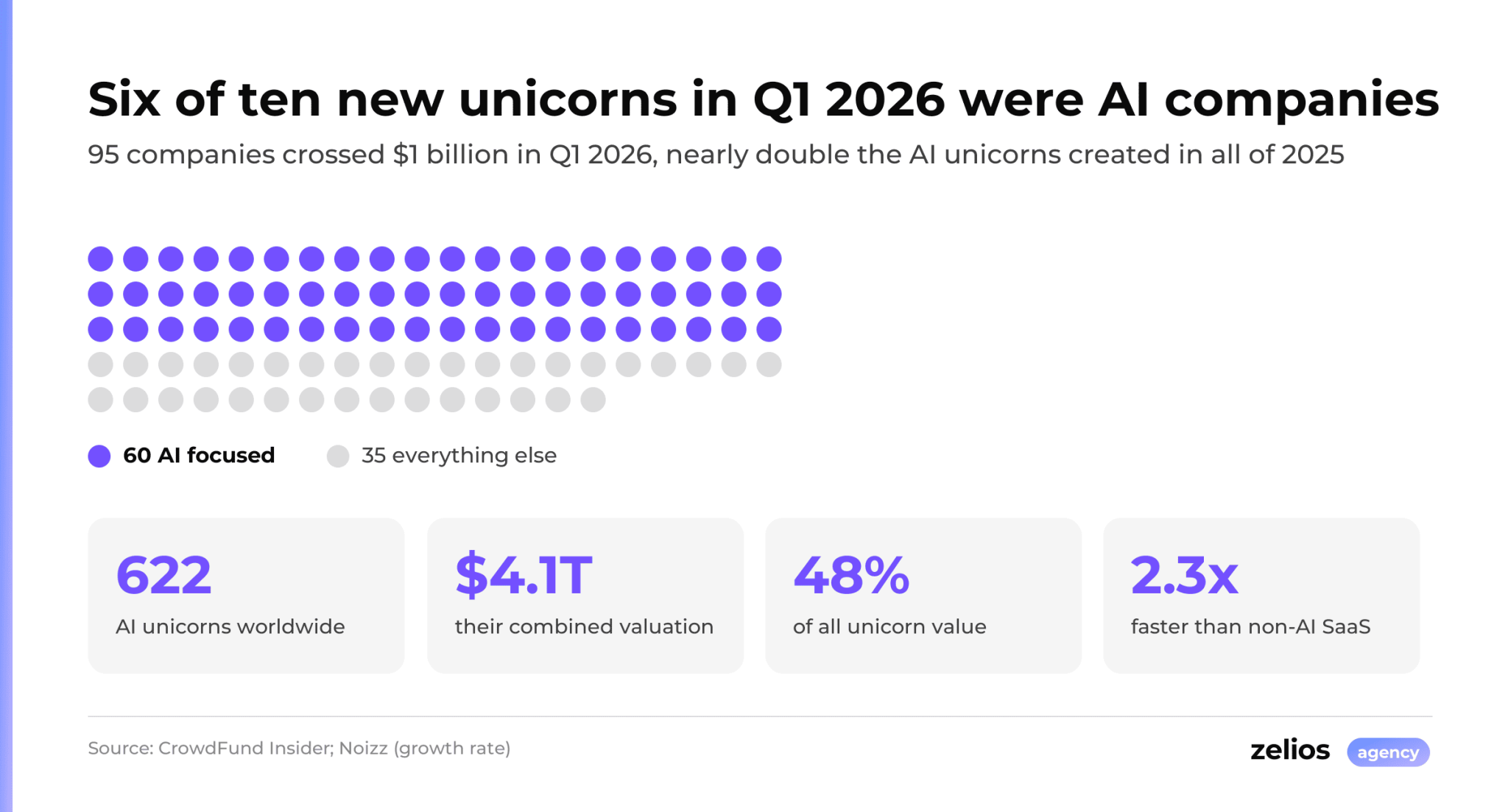
24. Currently, there are around 622 AI unicorns globally, with a combined valuation of nearly $4.1 trillion — about 48% of the world’s total unicorn value. – CrowdFund Insider
25. 64% of SaaS companies incorporate AI as a supporting feature, while 36% consider it to be the core foundation of their product. – High Alpha SaaS Benchmarks Report
26. AI-native startups are growing at an unprecedented rate. For example, Cursor grew from $100 million to $2 billion in annual recurring revenue in just 14 months. – Bain
27. Gartner predicts that 40% of enterprise applications will feature task-specific AI agents by the end of 2026. – Gartner
Takeaways
The growth is uneven. General-purpose SaaS software is still the bigger business, but it isn’t where the money is moving.
“AI-native products are expanding at a rate 2.3 times faster than other products. Vertical tools grew 31%, while horizontal platforms grew 28%. Most early-stage VC funding for software now goes to AI-first companies. ”
Pricing is the pressure point. Usage-based models are expected to account for 20% of SaaS revenue by 2027. Per-seat pricing becomes less effective when AI agents outnumber employees as users.
For marketers, the most cost-effective growth strategy remains the same: organic search and content marketing cost 40% less than paid channels and generate 110% more conversions.
Are you an ambitious SaaS, AI or tech brand? Zelios can help you develop a customized video strategy to boost your growth. Get in touch and let’s get to work!
Select the video type that aligns with your marketing objectives, and receive an immediate high-level estimate of the production cost.