


Rich media advertisements are dynamic forms of digital advertising that not only take advantage of but also intersperse video, audio, animations, and different kinds of interactions as the main aspects of them, thus forming a highly captivating experience for the user.
These novelties in the digital advertising world do not only make the user see the ad like a traditional static banner nor just the creator either.
According to eMarketer, ads using rich media formats outperform standard banner ads. They outperform them by an incredible 267%.
What Are Rich Media Ads, And How Do They Work?
The rich media ads are powered by robust programming that supports the following:
- Content channels in layers
- Monitoring of user interactions
- Modification of contents based on user preference
- Instant feedback on engagement metrics
Rich media advertising employs the technology that features such interactivity for example:
- Mouse movement detection for responding type of interactions
- Icons for the user to expand that would lead to further details
- Play of the video within the ad even when scrolling
- Link to social media for aspects of the ad showing the user’s activity
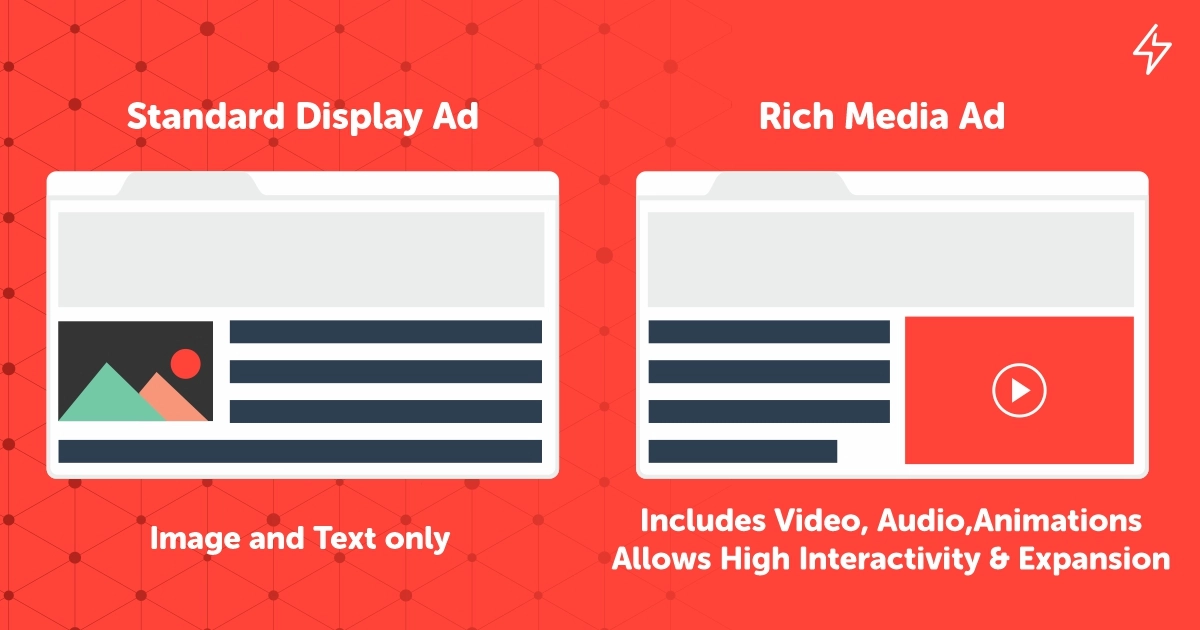
Rich Media vs. Standard Display Ads
The clearest way to understand rich media is to see how it differs from the formats it replaced.
| Feature | Standard Display Ad | Rich Media Ad |
|---|---|---|
| Format | Static image or GIF | Video, animation, HTML5, interactive elements |
| User role | Passive viewer | Active participant |
| Interaction | Click only | Hover, expand, swipe, play, scroll, game |
| Metrics tracked | Impressions, CTR | Interaction rate, dwell time, video completion, expansion rate |
| File size | Under 200 KB | 200 KB to several MB |
| Production complexity | Low | Medium to high |
| Engagement lift | Baseline | Up to 267% higher than standard banners |
| Best use case | Retargeting, brand recall | Product demos, launches, awareness campaigns |
The key distinction is simple: if a user can only look at it, it’s display. If they can do something with it, it’s rich media.
Examples of Rich Media Ad Formats
Common types of rich media ads include:
Expanding Ads
- Expand when users hover or click
- Reveal additional content without leaving the page
- Often used for product demonstrations
Interactive Banners
- Feature games or puzzles
- Include product configurators
- Offer multiple clickable elements
Video-Rich Ads
- Autoplay capabilities
- Interactive video elements
- Click-to-play features
Floating Ads
- Move across the screen
- Follow scroll behavior
- Create immediate visual impact.
Rich media advertising is one of the most effective tools for marketing campaigns today and it comes with many pluses to its credit such as engagement opportunities that are stronger than ever and measurable results.
One of the defining advantages of rich media over standard display is the depth of data it generates. While a static banner gives you impressions and clicks, rich media surfaces a full behavioral picture of how users actually engage with the creative.
